
The Tramping Camp Of The 1st Dundee Troop Boy Scouts 1911
Introduction
In January 1908 Lieutenant General Baden-Powell's 'Scouting for Boys' was published in six-parts, 'every other Wednesday'. It was very popular with young boys, no doubt brought up on tales of the Boer war, and fired their imaginations!
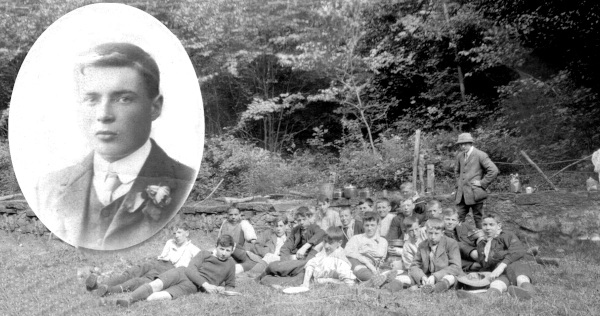
According to family legend my grandfather, a handicrafts teacher, was asked by some boys in his charge to help make staffs, essential equipment for a 'scout' to be. This raised his interest in the budding Boy Scout movement. He went on to form the 1st Dundee Troop of Boy Scouts and obtained his Scoutmaster's certificate in 1910.
In 1911 it was proposed that his troop undertake a 'tramping camp' into the Scottish Highlands. By then the troop was well-established, having their own 'trek waggon', based on army equipment of the time, fitted with demountable 'artillery wheels' and made to be easily broken down into its component parts.
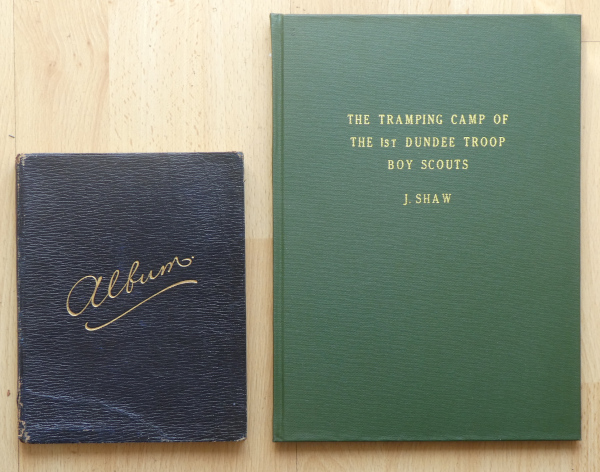
One of the boys, A. Edwards, kept a log and wrote it up into a souvenir album. He left spaces in the text into which Jack Edwards, (his brother?), drew ink sketches.
Because there was only one copy of the account, and because it was handwritten, in 1996 I transcribed the account and scanned the drawings to make a book that as far as possible retained the page layout, but in a more easily read form.
I had several copies printed, giving one to each of my grandfather's children. This digitised version was later to form the basis of my first website.
Preface
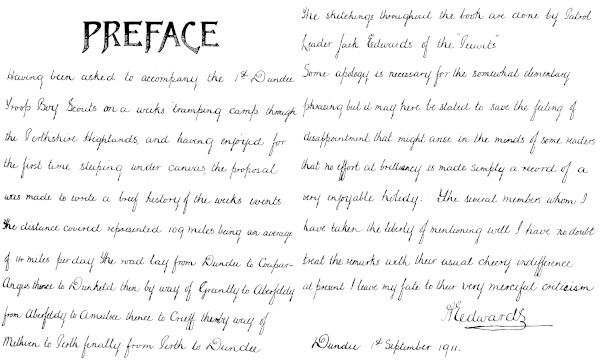
Having been asked to accompany the 1st Dundee Troop Boy Scouts on a week's 'tramping camp' through the Perthshire Highlands, and having enjoyed for the first time sleeping under canvas, the proposal was made to write a brief history of the week's events.
The distance covered represents 109 miles being an average of 14 miles per day. The road lay from Dundee to Coupar Angus thence to Dunkeld then by way of Grantly to Aberfeldy from Aberfeldy to Amulree thence to Crief then by way of Methven to Perth finally from Perth to Dundee.
The sketchings throughout the book are done by Patrol Leader Jack Edwards of the "Peewits".
Some apology is necessary for the somewhat elementary phrasing but it may here be stated to save the feeling of disappointment that may arise in the minds of some readers that no effort at brilliancy is made simply a record of a very enjoyable holiday. The several members whom I have taken the liberty of mentioning will I have no doubt treat the remarks with their usual cheery indifference at present I leave my fate to their very merciful criticism.
A Edwards
Dundee 1st September 1911
The Route
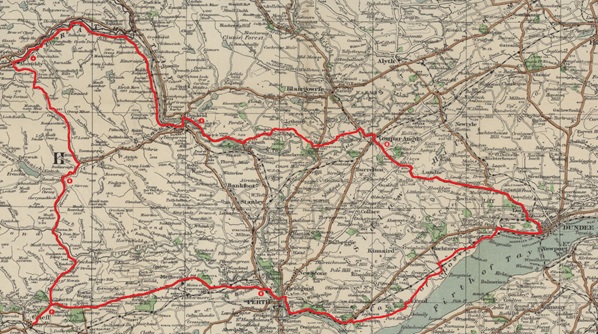
The troop started out from their headquarters at Dudhope Castle, Dundee on Saturday 22 July 1911. They headed west to Aberfeldy, then south to Crieff before turning east back to Dundee, arriving late on Sunday 29 July 1911.
Itinerary
Day One - Dundee to Coupar Angus
Two o'clock on the 22nd July 1911 we cross the square to Barrack Castle from whence, at 3 p.m. prompt, we are to sally forth with our Trek Waggon on that long projected tramping camp. After the final arrangement on Friday evening we had agreed to start at 3 p.m. and now the time had come and we were all very keen.

They are off!! Ben Boyd and Jim McLean are in the 'trams', Davie Conning and Willie Cumming have the front rope, Bob Melville and Sid Ramsay take the sides, while Jack has the wheel. "Watch the step at the door, there, take it very slowly, that's all right, now round the corner." Round the corner she goes and everybody is marching in grand style.
Lochee High Street, we are now fairly on our way, "Keep a good step chaps, there are lots of people watching."They are going to walk through Perthshire", says one, "They will turn when they reach Birkhill, says another. Ah! Cynicus, Cynicus, how little you know of the 1st Dundee Troop of Boy Scouts.
We are clear of the city boundary, and on the fine soft roads we are going easier, we are going grand. Honk! Honk! & "Left incline" we clear the way for the Birkhill bus, as she rounds the corner into the village. We halt for a while and Conning marks our route for those who are coming later.

Away from the madding crowd away from the haunts of men we begin to feel the fine country air we begin to feel enjoyment.
A 'Gentleman of the road' now observes us he watches us closely he sees our pots and pans and begins to wonder if his occupation has become fashionable.

'Tramp, Tramp, Tramp, the boys are marching!' from the road we see Kinpurnie Hill quite close and above us half a mile on the way to "Tullybackit" we halt at a small shop by the road and partake of Lemonade and Biscuits. Refreshed and ready we swing down the hill at a good rate and now see the village of Coupar Angus lying below us. Camping ground for the night next calls our attention and on reaching a small Beech Wood by the road we set out to get permission to pitch our tents.
After a good deal of delay and through the kindness of the Landsteward (Mr Hogg) the owner grants our request.
Through the wood to a sheltered corner the waggon is pulled and on a level patch we commence to unload.
Soon the tent is unrolled, and the hammer of pegs may be heard.
Boyd undertakes the duty of fireman, McLean goes to get water, while Melville and Ramsay go off to the station to meet Ferguson who is coming by train. The Marquee is now up, the blue smoke of the fire is now rising, and the Tea Urn is singing on the "Hob".
With the aid of a kindly old couple from a cottage over the way, who have given us water, milk and firewood, we are able to sit down to tea. At this moment Melville and Ramsay return telling us they could not find Ferguson (who had come up some time before) but smelling strongly of hot pies, gave us the impression, that they had been more zealous in their search for something to eat, than for scout George Ferguson of the "Wolf" Patrol.
From his seat on a baggage box, and between his mouthfuls of bread and butter, Conning surveys the scene. "This is a rare camping ground but!!", for a moment his enthusiasm dies away, "I have not seen a girl yet."
Ah Conning, Conning, you fascinator of fascinators, soon you will have full scope for your genius.
"We will have to go to bed now", Ramsay makes the proposal and is strongly supported by his pal Melville. Everyone agrees to turn in as it is now 10.30 p. m., Conning is to go into the village in search of sweets and a newspaper, while Boyd, McLean and Ferguson are to act as first guard from 11 till 1 a.m.
Most of us by this time are under blankets lying discussing the days march, which is interrupted by the return of Conning laden with Caramels, Toffee and chocolate candies, and a Sporting Post, which he hands to their respective owners.
Soon the whole tent is quiet we are lulled to sleep, to the music caused by the chattering of the teeth of the sentry at the door.

Boyd and McLean, are on guard on the road, where they are to wait for Cargill and Reid, who are to Cycle from Dundee, after 10 o'clock, and expect to reach us by midnight.
"Hark! what is that", there is a sound of rivalry by night, we sit up blinking, and hear, the challenging voices of the guard on the road, then all is still.
We wait in horror, till the sentry at the door informs us that a party of berriepickers had wished to camp with us for the night evening but seeing the threatening staves of our guard pointing straight at them could do nothing but retreat. So we turn over and go to sleep again as it will soon be our turn to get up. "Stop that", "Stop that", I awake to see Boyd poking Jack with a stave "It is One o'clock now and you are on guard" so Willie Cumming, Jack & I get up and go out into the darkness and cold, to watch for two long hours.
We walk up and down for half an hour or so to keep ourselves warm, when the sound of a bugle breaks the stillness of the night, we make a rush for the gate to meet Cargill and Reid who have just arrived.
We conduct them through the wood to the camp, where they go off to bed, while we continue another hour's dreary waiting.
↩Day Two - Coupar Angus
Day is beginning to dawn, and the sun is now rising, giving promise of a glorious day, we return to disturb the slumbers of Conning, Ramsay and Melville, who are to act as guard till 5 a.m.
As I go off to sleep for the second time Conning comes in with some Raspberries he wakes Cargill and gives him a handful, while Cargill, though very profuse in his thanks, does not seem to understand the favour that is being done him, for when Conning goes out again he lays his head down on the berries to awaken in the morning to the fact that his face is covered with red juice and an occasional berry sticking in his hair.
The return of the guard wakens the whole tent, and we all get up to prepare breakfast.

McLean goes of to a neighbouring farm to purchase eggs, while we busy ourselves gathering firewood and getting water.
"Good morning Gentlemen", the old lady from over the way appears at the tent door with a pitcher of milk, and we sit down to our second meal at camp.
Conning's "Rasps" now occupies the minds of a few and they go off in search of them while we others lay basking in the sun.
"Who will clean the potatoes", somebody volunteers some other body is to watch the rice while it boils and we sit round the fire for two hours patiently waiting dinner.
At last, it is ready the potatoes and cold meat taste splendidly, but the rice is slightly burned, and the cook lets us understand he likes it best when it has been singed as he called it.
The brushing of boots and dressing now take up everybody's attention. I hear Conning bemoaning the fact that he has left his fancy vest behind. With a far away look in his eyes he tells us of its splendour, the beautiful white background the soft yellow check, dotted here and there with pearl buttons.
The village of Coupar Angus is somewhat disappointing though the surrounding districts are very pretty, but here again Conning gives vent to his disapproval as this ancient parish cannot at the present moment boast of the very necessary establishment of a vendor of fried fish and chip potatoes to that delicious repast he informed me in a sudden burst of confidence he was devoted.
There is a shout from the road at this moment and we see coming through the gate another member in the person of Corporal J. Rodger, who has cycled up to meet us here.
We start to pitch another tent as there is not room enough in one to hold us all, this does not take long, and in ten minutes it is ready. Our friend the landsteward (Mr Hogg) again visits us, and he wishes to know if we are all comfortable, we inform him we are getting on splendidly, and he leaves with us some honey which we enjoy at tea.

As we have all returned to camp again we light a candle and indulge in the Singing of hymns followed in hot pursuit by a "Flute duet" and a "Solo" on the Melodeon which though not always having a large amount of the sacred element yet being rendered with a certain excellence.
Having exhausted our vocal powers and gradually relapsed into silence we one by one move off to bed and soon again the camp is wrapped in quietness.
The stillness was broken by a burst of laughter from the first tent the cause being Ferguson telling some huge joke and though being asked over and over again to tell the story once more he steadfastly refused.
At 11 p.m. I returned to waken Boyd and McLean, who get up with the intention of keeping guard till 1 a.m. but after 5 minutes they come back to say that there is nobody about and it is very cold suggesting they would be better in bed, so we sleep that night without a guard and better than the first.
↩Day Three - Coupar Angus to Dunkeld
Being troubled by a cold wind blowing in at the foot of the tent, and having tramped on another chaps face, I decided it would be better to get up, so at 4.30 a.m. the whole camp rose to prepare for our journey to Dunkeld.
Once more we commence the backing of baggage, now we roll up our tents, and they are ready for the waggon.
We breakfast at 8 a.m., seated on the grass, and express ourselves quite fresh and ready for the walk.
We return with the waggon through the wood, and close the gate behind us, on what has proved to be a very pleasant week end, and hope for as good luck in the next place.
Halting for a moment at the cottage over the way, the old folks wish us a pleasant journey, we thank them for their kindness, and agree, they are both "jolly good fellows".
Left! Left! through the village of Coupar Angus we now go, keeping a good pace, we round on to the Dunkeld road.

By the banks of the river Isla we continue our route, we pass a caravan bearing the inscription "We like sheep have gone astray".
A Hawker in his "go cart" now pass, he hails us with the shout "Go it me little lads".
Further to the north of us, we enter the village of Meikleour.
We all enter the Post Office, and Conning displays half a dozen postcards, to the favoured few of his admires, each bearing that strange device, "How are you enjoying your little self".
Continuing on our way, we greet a carrier "Good morning", he waves to us from his cart as we pass, while here and there a ploughman stops his work to watch us.
We gallop down the hill, through the village of Spittlefield, to the shouts of the youngsters by the way, and the astonishment of the rustic at his door.
Reaching the village of Caputh we are subjected to a heavy downpour of rain, but a friendly dairy farmer opens his barn to us, and here we partake of Lemonade and Sandwiches, while we wait for the weather to improve.

After half an hours rest we continue on our way all hands are at the ropes as we encounter a very steep incline in the road.
Steadily on for 2 miles increase our speed, and arriving at a small wood, we shelter again from the rain.
"Here comes Mr Shaw", we rush out to meet him, and the camp is now completed by the presence of the Scoutmaster.
We move off again and meet the gaze of a bunch of tinkers, by the side of Birnam wood we march, and see Dunkeld in the distance.
After a brief interview with Mr Niven the butcher, from whom we have purchased three pounds of his best sausages, he allows us the use of his park for the night.
Our fire is now burning brightly, Mr Shaw superintends the cooking, he being a past master in that art, and sitting at the tent door the delicious odour of frying sausages reaches us. The bugler sounds the call "ome to the Cookhouse door boys" and we sit down to dine, our operations being watched with great interest by a crowd of spectators from the Bridge.

Clattering of plates and splashing of water announces the fact that dinner is over we now prepare to go into Dunkeld we have all heard of it but none of us have seen it.
The Old Cathedral first claims our attention, we now enter the half ruined edifice, & the stone hewn figures on the walls look down upon us as if complaining we have disturbed their "ancient solitary reign".
Down the narrow street we wind our way, and meet an old native, who tells us of the places of interest, and directs us the best way to go.
Returning to camp about 10 p.m. very pleased with our sojourn in Dunkeld.
↩Day Four - Dunkeld to Aberfeldy

6 a.m. Tuesday morning, finds us wading in the river Tay, which flows past our camp by the side of the bridge.
Feet inspection is the order of the morning and 'Cold Cream' with bandages is handed out to the owners of blisters etc., one unfortunate member displays a foot with toes entwined like 'Siamese Twins'. he is in receipt of much sympathy, and the motto wear larger boots.
Down again on the ground are our tents, the wheels of our waggon are being fastened on.
At the moment a neighbouring caravan which has been with us all night leaves the field to take the same road as we are to go later to Aberfeldy. 10 a.m. we pass the sign post, farewell Birnam woods, farewell Dunkeld, once more on the lone trail we trek north.
On either side of the river lay long fields of Barley and of Rye the sweet fragrance of Laburnum reaches us. The lark rises warbling the song sweet & clear on the still morning air the sun shines down in splendour upon us as we go marching along.

Our advance cyclist returns to warn us of a steep descent at the turn of the road, but we take no heed, and start at a gallop. From a cloud of dust we emerge at the foot, and halt to see Melville, who has not taken well with our wild rush down, but still hung on to the rope, well done Melville!!.
Easy does it at an easy pace we keep going on and see in the distance the Caravan which had left Dunkeld almost an hour before us. With a triumphant shout we pass and feel sorry for the poor "nag" that pulls. A scout from the front rope enquires if the iron shoe hurts the horses feet and with great gusto Mr Shaw replies "It 'aint the 'osses 'ooves, that 'urt the 'osses 'ooves, it's the 'ammer, 'ammer, 'ammer of the 'osses 'ooves, on the 'ard 'ighway".

So for the next mile or more, we meditate, over the 'ammer, 'ammer, 'ammer, of the 'osses 'ooves.
The sun over our head tells us mid-day, seven miles on our way, 10 more to go, and still we are marching along.
Lunch is the next item on our programme so off goes our cyclists in search of refreshments and halting at a farm we enter the park to satisfy our hunger with sandwiches and milk.
We stretch ourselves on the grass and enjoy the pleasure of the warm sun before resuming our journey.

"Glory, Glory, Glory, Hallelujah!"" again we are marching along. On the other side of the river we see Ballinbuig and faintly hear the roar of the falls of "Tummel" from the road.
We come upon a cluster of bushes laden with Raspberries not a sound is heard not a bugle note for the scouts are silently feasting.
A Church Spire surrounded by a number of houses looms in the distance now we take a turn in the road and enter into Grandtully.
We halt for a moment to enquire our way then emerge at the other side of the village on the main road to Aberfeldy. For a mile or so we steadily climb now a party of Farm Labourers greet us now we pass the village postman on his rounds.
At this point I go off with Cargill in search of camping ground and making a stop half a mile from Aberfeldy we see a suitable place and go to get permission. Here again luck favours us as the owner readily grants our request. We commence at once to build a fire so that it may be ready by the time the others get up.

As the smoke curls skyward the advance cyclist makes his appearance and is soon followed by the main body who enter the ground at this moment.
Once again the hammering of pegs may be heard. Our "Marquees" again take up their position, once more the tea is singing on the "Hob" once more we sit down to dine.
But alas an unpleasant surprise awaits us having found it impossible to get milk we had decided to use Condensed milk and not understanding how to use it we allow it to burn spoiling altogether the taste of the tea. As we gulp it over we remember the words
'Theirs not to make reply
Theirs but to do and die
Not tho' the soldier knew
Someone had blunder'd'.
At this moment two strangers enter our camp dressed in scout Garb they are Scoutmaster Moon of the 64th Glasgow Troop and his brother they have walked down from Kenmore and wish to pitch a tent with us for the evening. We are very pleased to help and soon their tent is beside our own.
The proposal to have a concert is made so we enter the 'Marquee' and sit down.
It opens brilliantly with a 'flute solo' "Annie Laurie", then Rodger sings us the joys of 'the day he went to Rothesay Oh'. Conning now obliges with a coon song about 'Whistling Rufus and his one man band'. Mr Moon on being called upon renders "Clemintine" and we all join in the chorus. Jack recites to us about "Bill the scout and the burglar" but after a few dramatic passes with his hands sits down in the middle of it. Mr Shaw now chimes in and sings us the story of "The bonnie wee Window". Again we call upon Rodger and again he responds giving us a parody on "Asleep in the Deep". McLean is indisposed having discovered he has a very bad cold. Willie Cumming is in the same position so again we call upon Rodger and again Rodger responds. Time flies 10.30 p.m. we decide to have a last chorus we nerve ourselves for the final effort and burst out in "Poor old Jeff way down in Tennessee".
Darkness has descended upon us and we go out to sit by the river and enjoy the coolness of the evening.

We bid the angler on the bank "good-night" and turn in.
↩Day Five - Aberfeldy to Amulree
The sun is shining brightly when we awake in the morning though the mist lies thickly on the hills and a cloud hides our view of "Schiehallion"
While in the midst of breakfast preparations we hear sad news. Melville brings a newspaper in which we learn that two of the scouts of the 3rd Dundee Troop have been drowned in the river near their camping ground at the "Bridge of Earn". While returning in a boat after having assisted in putting out a farm fire the boat upturned throwing two of its occupants into the river and causing them to lose their lives. Having known Cameron and Brown very well we are all deeply moved by the sorrowful news recognising Dundee has lost two of her most enthusiastic scouts

Rodger leaves us at this moment to cycle to the Bridge of Earn bearing with him a message of sympathy from Mr Shaw and us all to Mr Lorimer scoutmaster of the 3rd Dundee.
We go for a walk through Aberfeldy and visit the "Black Watch Monument" then return about 2 o'clock for dinner.
Loaded again is our waggon and once more we are on our journey this time our destination being Amulree.
Across the square we now march and reaching the main road we commence the steep climb of three long miles.
Steady, Boys Steady, steadily we pull the waggon and pass the 'Birks of Aberfeldy' we halt to have a rest a mile on our way.
At this stage a party of Holidaymakers come up to us and tell us of the difficulties of the road further up but nothing daunted we move on.
On either side great hills rise while all around us is one vast moor and as far as we can see not a single house is perceivable.
Excelsior!! higher and higher we climb till reaching a small brook we call another halt.

"Oh for a draught of vintage" a spring of cool clear water is close at hand so we refresh ourselves from the stream.
At last we see half a mile higher up the outline of "Loch-na-Craig" which is the summit of our three miles climb.
Again we are going faster as we turn down the road by the side of the loch.
A cloud of cold damp mist comes down upon us bringing with it a shower of rain and again we halt to get out our waterproofs.
Reaching a small farm a cyclist goes off in search of milk but comes back with the news that the man at the farm had told him "She didna' keep a Coo' "
Round the road we meet a baker with his van and purchase from him some bread for tea.
Away again go the pioneers in search of ground and on reaching Amulree Hotel we ask the use of their park for the evening.

The genial proprietor grants the necessary permission and we are conducted through a field at the foot of the hills where we come upon our friends in the Caravan again.
One chap starts to build a fire another goes to get firewood while a third goes back to show the others the way. Through the rough field we pull the waggon and begin to pitch our tents before the darkness descends upon us.
Seated at the tent door we can distinguish the figures of the cooks through the gloom against the red glare of the fire as we patiently wait for tea. The return to the "Tea Urn" is the signal to dine and wolfishly devour this well earned meal.
Soon the camp is wrapped in stillness broken occasionally by the calls of wild birds on the hills.
↩Day Six - Amulree to Crieff
4.30 a.m. next morning Mr Shaw and I get up to prepare breakfast while the rain comes down in torrents.
I awaken Cargill and he and I go down to the village to get milk while Mr Shaw endeavours to light the fire.
We hammer at the farmhouse door and the angry farmer puts his head out of the window to enquire what we want at such an early hour saying "She will just be six o'clock".

After some persuading he comes down and gives us all he can spare but not getting enough we go to the Hotel in search of more.
On asking for the cook she brings out a loaf and pitcher of milk so we return through the rain to the camp. The fire meantime has refused to kindle as the rain damps the firewood immediately it is put on.
On going up to the schoolhouse for water the Schoolmistress on learning the difficulties we are having with our fire she asks us to cook the breakfast on the fire she has in the schoolroom.
We carry our pots into the school to the amusement of the children in the Class.
They watch with great delight Mr Shaw as he stirs the porridge and if a stranger happens to ask of our visit to Amulree he will hear the children say "Oh wasna' he a roguie the scoutmaster o' Dundee".
After breakfast the weather shows signs of improvement, and preparations are being made for our journey to Crieff. Once more on the road we stop at the school, to say "goodbye" to the Schoolmistress, and she waves to us from the door.
By the side of the hill we are marching, to the right lies an open stretch of country with fields of yellow corn, waving in the wind, and away to the north the "Grampians" stand out against the sky line.

Droves of Pheasants rise startled from out of the moor and hundreds of rabbits race up the hills as we pass.
By the village of Newton our way now lies and half a mile further is the entrance to the Sma' Glen.
Halting at a small shop we sit down by the road side and indulge in more Lemonade and Biscuits.
Into the glen we march along between the hills that rise on either side covered in purple heather.
We drink in the beauty of the scene before us in this part of the "Land of brown heath and shaggy woodland of the mountain and the flood".
Down the mountain side rushes a stream, and sparkling out among the fern, chatters over stony ways, while the netted sunbeams dance against its shallows, it bickers down the valley.

Under a little rustic bridge it flows, and bubbles through the brambly wilderness, to join the brimming river.
Reaching the other side of the Glen the country again opens before us.
The river Almond crosses our path, and winds its way in and out, by grassy plots, and is lost to us midst bowers of over-hanging willows.
By shady woods, and sheltering hills, we go, sometimes a party of tourists pass sometimes a shepherd on his homeward way accompanies us as we march.
The village of Gilmerton looms before us, lying in a hollow half a mile on the way, and at this moment the cyclist go off in the Crieff direction on the look out for camping ground.
Halting outside the town at a little wood beside a quarry permission is granted us to pitch our tents.
On the arrival of the waggon, we pull it up the slope, to a level stretch of ground behind some trees.
Our tents are again being pitched, while a few see to the building of a fire, others go to get water.
Under the personal supervision of Ramsay who has earned for himself the title of the "Chief Blower" the fire burns brightly, and our tea is almost ready.

We make an excellent meal of mince and potatoes followed by tea with bread and jam.
Having washed up the dishes we dress, and go to have a look round Crieff.
We form in two deep and all walk into the town together.
Through the principal streets which are thronged with crowds of people who at this time of year come to spend their holidays here.
An occasional youth greets us with a sarcastic remark but we leave Conning to retort which he does admirably and comes off with the honours of the combat.
Entering an Ice Cream shop we celebrate our visit to Crieff with an Ice drink then return to camp. The darkness has fallen while we prepare to go to bed and the rain is coming down heavily.
↩Day Seven - Crieff to Perth
At 8 a.m. next morning when the "Reveille" is sounded we scramble into our clothes the sun is shining brightly down upon us.
Cargill & Reid cycle into Crieff to purchase provisions for breakfast.
Ramsay takes up his usual position at the fire while others get water, firewood etc.
The mysterious disappearance of half a dozen scouts causes some anxiety but after half an hour they return laden with Raspberries and telling of a place in the wood where they could be found.

We prepare the breakfast table which is made up out of the bottom of the waggon and dine on fresh country eggs with salmon by way of dessert.
Our day's march lies by way of Methven to Perth which is a distance of 14 Miles so we start to arrange our baggage for the journey.
We wheel the waggon across the field to the road and carry across our baggage to have it loaded.
Through the gate to the main road we retrace our steps and steadily march forward while Crieff gradually fades away in the distance behind us.
Reaching Gilmerton we take the road to the right which points to Perth.
To the accompaniment of "John Brown's Body" we march our deep throated chorus startling the inhabitants in the little cottages by the road who come out to view us as we go marching along.

Swinging steadily along we pass an old stonebreaker enjoying his noon day meal while motor after motor goes hooting past leaving behind them great clouds of dust.
A Car at this stage slows down and the lady kindly invites us to have some tea but as her house lies two miles off our way we thank her and decline.
She compliments us on the way we are marching and invites us to come to her house if we are in the district again.
Willie Reid has to leave us at this moment as it is necessary for him to be in Dundee by Friday morning to start work so we give him a cheer as he cycles off.
We continue on our way by farmhouse and cottage till we reach the village of Methven.
We halt here and pull the waggon into the side of the road and enter a tea room in search of refreshment.
We are conducted through the shop to a room upstairs and sit down at a table which groans under the weight of buns and cakes.
Slowly but surely they disappear and soon nothing is left but the plates. We ring for the girl and astound her by asking for more.
After a brief rest we move off again and on reaching Huntingtower Cargill & I leave for Perth to arrange camping ground.
A field at the entrance to the town draws our attention and on getting permission we start building a fire.

As the fire shows signs of kindling the main party arrives so we set about pitching our tents again. Within half an hour they are in position and the cook at the fire shouts that tea is ready.
While we are in the midst of our meal we are subjected to the gaze of a crowd of spectators from the neighbouring houses.
Having washed up the dishes we dress and go for a look round the "Fair City".
After having visited the "fair maids house" and viewed the principal streets we return to camp as it is now 10.30 p.m.
By 11.30 we are all under blankets and soon the whole camp is still.
↩Day Eight - Perth to Dundee
By 6 a.m. next morning we are all astir though Conning and Melville had been up half the night driving off some cows who had threatened to wreck our tents while we had slept quite unconscious of the danger.

As we are preparing breakfast a party of maidens enter the field they cannot resist Conning's captivating manner and soon they are the best of friends.
He sits and beams down upon them and forgets for a while his blistered feet and the various hardships he has suffered on the way.
The order from Mr Shaw to come and clean the porridge pot awakens him from his dream and after a lingering farewell he returns.
The proposal to go to the swimming baths is made so we make our way there to have a swim.
After having each done a length or two and watched McLean give exhibitions on the water "schute" we return feeling quite refreshed.
We prepare an early dinner so that we may get started on our last and longest journey to Dundee.

By one o'clock the waggon is ready and a little later we take the road.
Clattering across the High Street we reach the bridge that spans the Tay and turn on to the Dundee road.
By the foot of Kinnoull Hill we rest while the rain begins to fall.
We harness ourselves once more to the waggon and march steadily on for another two miles.
On reaching Kinfauns we halt again and a rush is made to a little shop where we replenish our stock of Biscuits.
Into the heart of the "Carse of Gowrie" we wend our way and by long fields of yellow corn we tramp along the soft level road.
At a small shop a quarter of a mile above the village of Errol we order from the old lady some Lemonade and sit down on a bench in her garden and dispose of it. After resting a while we move off all hands are at the ropes as we encounter a steep incline on the road.
"When Johnny comes marching home again Harrah! Harrah!" Conning's feet are again troubling him and he feels very thankful that we are indeed marching home.

We rumble through Inchture and rounding the road we view the Tay and familiar scenery of the Fifeshire hills.
Reaching Longforgan we halt at the village grocer's and crowd into his shop in search of more refreshment.
Having revived our strength we pull out the waggon and continue again on the road.
Darkness is beginning to fall as we reach Invergowrie and from the road we can see the lights of Newport across the river.
We take the high road which runs by Liff station into Lochee

We meet the gaze of the people as we pass and hear with interest their remarks. "That is the same crowd that passed last Saturday" says one while an old lady remarks to her companion "Look at that poor lad behind, he seems to have a lot of bother with his feet".


9.30 p.m. we reach the gate of Barrack Castle and pull up the waggon to have it unloaded. We take down the waggon and carry it over to its corner while each takes his baggage and returns home.
Thus the camp is disbanded and with a feeling of regret we realise our march is ended.
No more to lie under the star shine and be lulled to sleep by the sound of rushing streams and the sighing of the winds.
So ends the journey of 109 miles, so ends the "Tramping Camp" of the 1st Dundee Troop Boy Scouts.
↩Postscript - Who wrote 'The Tramping Camp'?
Who was the author, A. Edwards? Was Jack Edwards his brother?
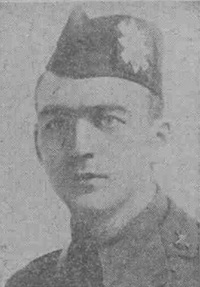
The 1911 Census for Dundee lists only two lads in the expected age range with an initial 'A' and surname 'Edwards'.
There was an Alexander L.C. Edwards, aged 20, living at 14 Thompson Street, Dundee with his father, David, mother, Jane and brothers, George, James and John. Brother John was 17 and might well have been known as 'Jack' and was certainly within the age range for a scout.
Alexander's first name initials, 'A.L.C.' must be rare if not unique. There was a Captain A. Linday Clark Edwards who served with the Royal Highlanders, 'Black Watch', during WW1. He was awarded the Military Cross in 1916. As well as having the same initials, i.e. A.L.C. it might be significant that, as with the Tramping Camp record, he reduces his given first name to just an A. He was also noted as being a secretary of the Tayside Scout Association.
Miltary records suggest that he served until at least 1929 when he would have been about 37. An Alexander L.C. Edwards died in Dundee in 1965, aged 74.
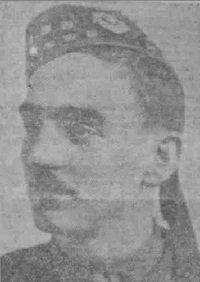
'Jack' Alexander Edwards joined the Royal Field Artillery in 1914 but transferred to the Royal Scots, being awarded the Military Cross as Lieutenant. A 'John Alexander Edwards' who had a mother with a maiden surname of Clark died in 1933, aged 39. Scottish naming conventions of the time, i.e. using names of paternal and maternal grandparents make it highly likely that this was the brother of A.L.C. Edwards.